







Register to get free articles
Want unlimited access? View Plans
Already have an account? Sign in
Legal reasons had prevented the organisation from announcing its hallmarking of the medals prior to the Games.
The Goldsmiths’ Company Assay Office’s hallmarking expertise was put to the test by the Queen’s Assay Master at the Royal Mint in Llantrisant, south Wales, where the Olympic and Paralympic Medals were manufactured.
Discussions were held at the Mint regarding the type and position of the mark on each medal, and how they should be assessed.
In total, the Royal Mint produced 4,700 gold, silver and bronze medals, and the hallmarking process was required for the gold and silver pieces. Gold Olympic medals haven’t been made from solid gold since the 1912 Olympics, but with a diameter of 85 millimetres, the London 2012 medals were the largest and heaviest ever made for a summer Olympic Games.
Including hallmarking, there were 22 stages involved in making the medals, with each one taking around 10 hours to produce. The gold medals are plated to guarantee the International Olympic Committee’s (IOC) specification of six grams of gold (minimum); contain a small amount of gold and copper; and are hallmarked as .925 silver. Meanwhile, the silver medal is also hallmarked .925 silver with the remainder of medal made up with copper, and the bronze medal is 97 per cent copper, 2.5 per cent zinc and 0.5 per cent tin.
Superintendent assayer John Love was the only non-Royal-Mint employee to be involved in the medal-making process. “Over my 37-year career, I have taken great pride in working for the Goldsmiths’ Company Assay Office and being part of marking the London 2012 Olympic Medals,” he remarked.
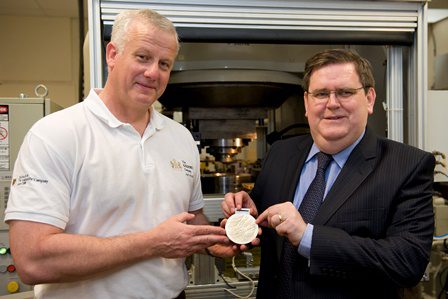
Image: Deputy warden Robert Organ and superintendent assayer John Love at the Royal Mint with one of the medals.