








Register to get free articles
Want unlimited access? View Plans
Already have an account? Sign in
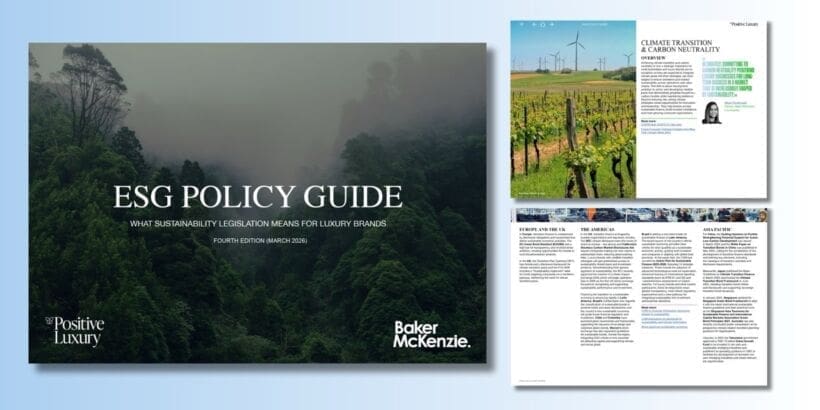
Positive Luxury and global law firm Baker McKenzie have produced cross-jurisdictional analysis indicating that ESG regulation across major markets in the luxury sector is becoming “increasingly prescriptive, interconnected and operational in nature”.
The groups’ findings suggest that global sustainability regulation increasingly puts practice before principles, operating on concrete rules on circular design, backed-up environmental claims, traceable supply chains and structured climate reporting.
According to the guide, regulatory activity is not only proliferating but becoming more mature, with regulators across Europe, the US, Asia‑Pacific, the Middle East and Latin America starting to overlap when it comes to the type of information and quality of supporting evidence they want from companies.
However, the report said approaches diverge in terms of pace and scope, meaning luxury brands operating across several regions at once must interpret how various laws interact and where requirements intersect.
It advises luxury brands to standardise their global practices before further convergence occurs, reinforcing governance and strengthening internal systems so they can meet regulatory demands.
Katia Boneva‑Desmicht, who leads Baker McKenzie’s Global Consumer Goods and Retail Group, said: “Across jurisdictions, we are seeing a shift toward clearer definitions, tighter claims standards and more structured reporting. The overall direction is consistent, even if the instruments differ. For luxury businesses, this is an important moment to take stock of internal systems and ensure they align with the level of transparency regulators now expect.”
Jamie Moore, Positive Luxury’s managing director, added: “Luxury is at a crossroads. As regulation matures across markets, sustainability is moving from aspiration to accountability. For luxury brands – and their suppliers – it is an opportunity to strengthen trust, embed transparency into operations and turn sustainability into a driver of resilience and growth.
“This Guide is designed to help brands to navigate that shift and move forward with clarity and confidence. Credibility will be defined not by what a brand promises, but by what it can prove.”